
Your Abbotsford Lawn Isn’t Just Brown — It May Be Gone Underneath
Every spring, Abbotsford homeowners walk outside to find their lawn torn apart. Strips of turf peeled back, soil exposed, crows and raccoons still working the edges. The damage looks like vandalism, but the cause is underground: European chafer beetle grubs, feeding on grass roots from October through to April, and the wildlife that follows them.
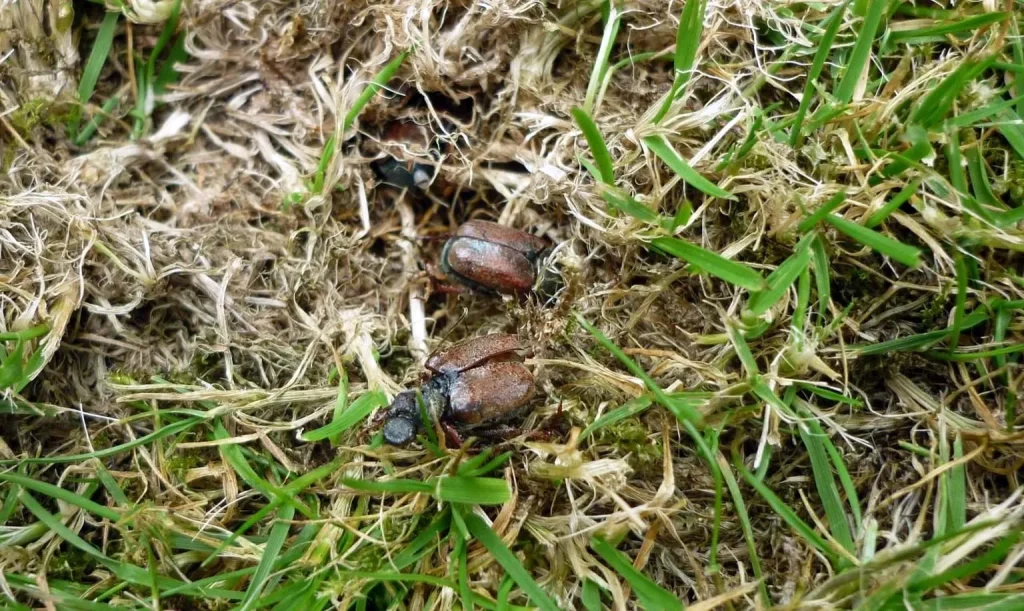
Adult European chafer beetles emerging from a damaged lawn — the dead, dry thatch surrounding them is a direct result of grub feeding on grass roots below the surface.
Abbotsford is one of the Fraser Valley communities most affected by the chafer beetle spread. The City of Abbotsford has acknowledged the issue publicly — city staff have been adjusting maintenance practices in parks and on boulevards for years, and staff continue to monitor and expand their management program as needed. Neighbouring municipalities are dealing with the same pressure. The infestation is not isolated, and it is not going away.
Contact us for a free evaluation of your chafer beetle infected lawn
For homeowners, the harder question is not whether chafer beetles are a problem — it’s what to actually do about a damaged lawn, and when surface-level repairs are worth the effort versus when full removal and proper site preparation is the more practical route.
How Chafer Beetles Actually Damage a Lawn
The European chafer (Amphimallon majale) was first confirmed in BC’s Lower Mainland in 2001. Since then it has spread progressively eastward through Metro Vancouver and into the Fraser Valley. The BC Ministry of Agriculture considers virtually all of southwest BC — including the entire Fraser Valley — either infested or at risk of infestation.
The damage follows a predictable cycle. Adult beetles emerge in late June and early July, typically flying at dusk to mate in nearby deciduous trees. Females deposit eggs in lawn areas, with each female capable of laying up to 50 eggs. By late July, those eggs hatch into grubs that begin feeding on grass roots. The feeding continues through fall and into early spring, peaking in the third larval stage — the final and most destructive stage before pupation.
Root damage below the surface is not always visible immediately. Lawns can look stressed or thin in late summer, but the most dramatic damage usually appears September through March, when raccoons, skunks, crows, and other wildlife detect the grubs and begin digging. This is where lawns go from patchy to destroyed: turf gets physically ripped up, soil is loosened and exposed, and what began as a pest problem becomes a grading and structural problem.
The BC Ministry of Agriculture notes that drier conditions accelerate visible damage — moisture can temporarily mask the effects of root loss. Abbotsford properties with south-facing lawns, thin topsoil, or areas that dry out in summer tend to show damage more quickly than shaded or well-irrigated lawns.
Assessing Your Lawn: What You’re Actually Looking At
Before deciding what to do, it’s worth understanding how bad the damage really is. The standard test is simple: cut three sides of a 30 cm x 30 cm square of sod to a depth of about 5 cm, fold it back, and count the grubs in the exposed soil. Repeat this in five different spots across the lawn. The threshold used by most municipalities is roughly five or more grubs per section — at that density, active management or replacement is typically warranted.
But grub counts only tell part of the story. The more important question is whether the lawn structure itself is still salvageable. Consider:
- Is the turf still rooted, or does it lift easily? Grubs sever root connections, and turf that pulls away with little resistance has lost its anchor. Re-seeding over a detached lawn achieves very little.
- Is the surface still level? Animal digging leaves ruts, holes, and raised patches. An uneven surface creates water pooling, muddy areas, and an inconsistent base that makes any new lawn harder to establish.
- How large is the damaged area? Spot repairs can work for contained damage — a section of the backyard, a strip along the boulevard. When damage extends across most of the lawn, or when multiple seasons of damage have accumulated, a full strip-and-prep is often more cost-effective than repeated repair attempts.
- Are there underlying drainage or grading issues? Chafer damage sometimes reveals pre-existing problems — low spots that hold water, areas where topsoil is shallow, or grades that direct runoff toward the house. Addressing these during a full restoration is far easier than retrofitting them into a patched lawn later.
Treatment Options — And Their Limitations
There are legitimate treatment options for active chafer infestations, and Abbotsford homeowners should understand what they can realistically accomplish before committing to a lawn restoration program.
Beneficial nematodes (Heterorhabditis bacteriophora) are the most commonly recommended biological control. These are microscopic organisms that target chafer grubs in the soil. Timing is everything: nematodes must be applied in mid to late July, to warm and moist soil, with consistent irrigation for two weeks following application. The City of Abbotsford recommends this approach, and it can be effective — but it requires hitting a narrow application window, and hot and dry summers have made nematodes less reliable in recent years. They also need to be pre-ordered and kept refrigerated until use.
Bacillus thuringiensis galleriae (BTG) is a newer microbial larvicide registered in Canada that can be more forgiving in timing than nematodes. It is available in both commercial and domestic formulations. The BC government notes that one or two applications per year may be needed, and that soil must not be frozen, cold, or dry at application time. Check with the City of Abbotsford regarding any local pesticide use bylaws before purchasing or applying any product.
Conventional insecticides are restricted under municipal bylaws in many BC communities. Some formulations remain registered federally, but local bylaws — as seen in Vancouver and other municipalities — can prohibit commonly marketed products like those containing imidacloprid or carbaryl. Always verify what is permitted in Abbotsford before applying anything.
One honest note: treatment manages population pressure. It does not un-do root damage already done, re-level a ripped-up lawn, or correct grading problems that animal digging has created. Homeowners who treat successfully still often need significant physical restoration work on the surface.
When Full Removal and Site Preparation Makes More Sense
For many Abbotsford properties — particularly those with several years of accumulated damage, large affected areas, or lawns where the turf has already lifted and the surface has been significantly disrupted — surface-level repair is a poor investment. You can re-seed or lay sod over a compromised base, but without removing the dead material, correcting the grade, and preparing the soil properly, the new lawn will struggle from the start.
Full removal and site preparation involves stripping out the damaged turf and loose surface material, correcting uneven ground and ruts left by animal digging, reviewing the surface grade and drainage direction, and establishing a clean base for new sod or hydroseed. Done properly, it resets the yard and gives the replacement lawn a genuinely solid foundation rather than a patched surface over a problem base.
This is the type of work that benefits from excavation equipment and an operator who understands grading and drainage — not just lawn care. VIP Excavating’s chafer beetle lawn removal service takes a site preparation approach: removing damaged material, leveling and grading the surface, and leaving the yard ready for sod or hydroseed installation. If the project also requires specific site preparation for new turf, that can be coordinated as part of the same scope of work.
Properties with sloping yards, known drainage issues, or heavy clay soil — all common conditions across Abbotsford — especially benefit from having grade and drainage reviewed at the same time. Abbotsford’s Fraser Valley location means soils vary considerably: flatter areas near the floodplain can have heavier, slower-draining soils where water retention after grub damage and animal digging compounds the problem. Hillside properties in upper Abbotsford may have thinner topsoil where root damage is more immediately apparent.
One More Thing: Japanese Beetle
Abbotsford homeowners dealing with lawn grub damage should also be aware that a Japanese beetle (Popillia japonica) trap in Abbotsford detected a single specimen in 2024, prompting a provincial Treatment Order in the fall of that year. Japanese beetle causes similar turf damage to chafer but is a regulated pest under BC’s Plant Protection Act, with movement restrictions on soil and plant material from infested areas.
For 2025, soil movement restrictions in Abbotsford were lifted, and increased trapping and monitoring was underway. If you are in an area with recent Japanese beetle detections, do not move soil or plant material off your property, and contact the Canadian Food Inspection Agency if you suspect Japanese beetle presence. The identification matters: chafer management is largely in your hands as a homeowner, while Japanese beetle response involves provincial and federal programs.
If you are uncertain which pest you are dealing with, the Fraser Valley Invasive Species Society has useful identification guidance for distinguishing the two.
Get a Free Quote from VIP Excavating
VIP Excavating provides chafer beetle lawn removal, grading, and new lawn site preparation for residential properties across Abbotsford and the Fraser Valley. If your lawn has been significantly damaged and you want a properly prepared starting point for restoration, we can assess the site and recommend the right approach.
Serving Langley, Abbotsford, Chilliwack, Mission, Surrey, Aldergrove, Maple Ridge, Pitt Meadows, White Rock, and surrounding Fraser Valley communities.
- Phone: (604) 309-3284
- Email: vip.excavating.ca@gmail.com
- Online: Request a free quote
VIP Excavating — excellence since 2008. Fraser Valley excavation and site preparation specialists.
Last Updated on 18 March 2026